Eiji Watanabe and Eiji Watanabe渡辺英司と渡辺英治
The same surname, the same given name, the same reading, born a year apart. On the left, the artist Eiji Watanabe; on the right, the neuroscientist Eiji Watanabe. Never crossing, they draw closer and meet in 2024. What the two share is placed in the middle.
Eiji Watanabe
Artist美術家
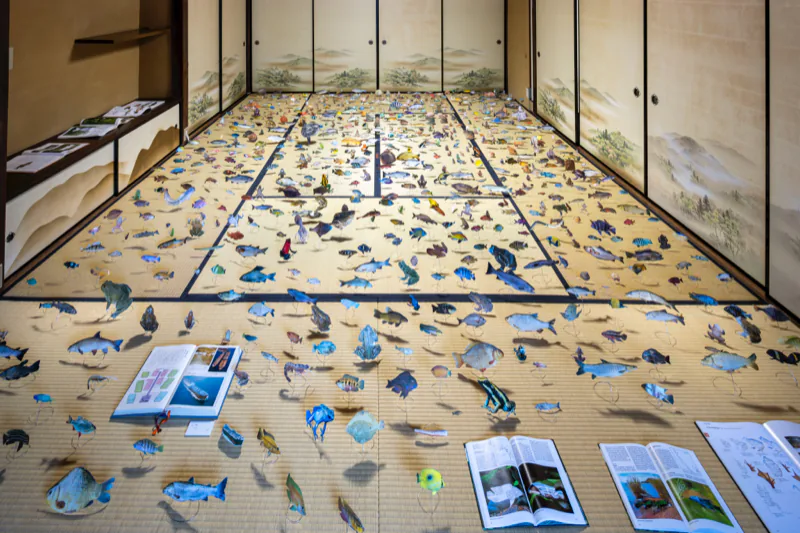
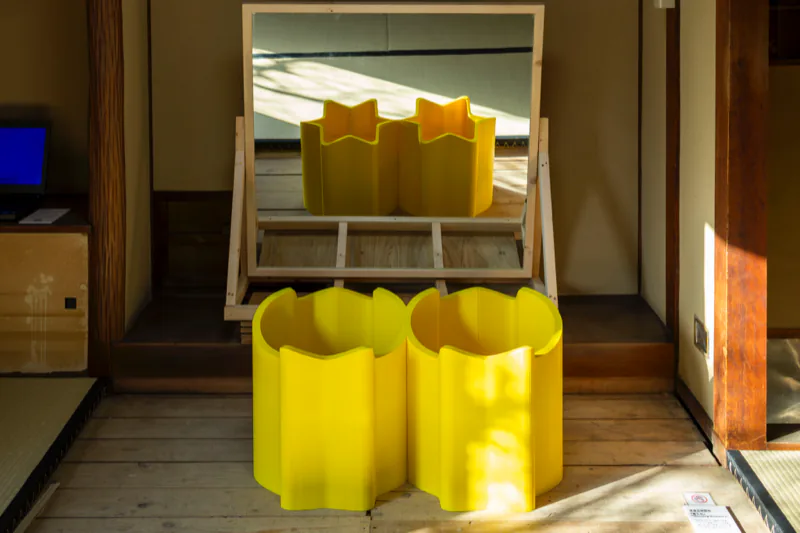
Born in Aichi Prefecture in 1961. Graduated from the sculpture course of Aichi Prefectural University of Fine Arts and Music in 1985. In 2004–2005 he stayed in Scotland as an overseas research fellow of the Agency for Cultural Affairs and was a visiting researcher at Edinburgh College of Art. Known for the “Garden of the Appellation” series of plants and fish cut out of illustrated encyclopedias, for titles that play on words, and for making places: Star Gallery, Art Obulist, Jingu339. He works in studios in Nagoya and Agui.
Eiji Watanabe
Scientist神経科学者
Born in the old downtown of Osaka in 1962. Graduated from the Department of Biology, Faculty of Science, Osaka University, in 1986, and received a Ph.D. in engineering there in 1991. Associate professor of the Laboratory of Neurophysiology at the National Institute for Basic Biology in Okazaki since 1998, and head of its AI analysis facility since 2022. He studies the brain’s sodium-level sensor Nax, vision and social behavior in medaka, and optical illusions and deep learning, and presents optical illusions of his own. His books include a beginner’s guide to deep learning for neuroscientists 『神経科学者と学ぶ深層学習超入門』 (Yodosha, 2025).
Parallel timeline 1961–2026パラレル年表 1961–2026
Eiji Watanabe (artist)Eiji Watanabe (neuroscientist)Shared
- 1961Born in Aichi Prefecture
- 1962Born in the old downtown of Osaka
- 1985Graduated from the sculpture course, Aichi Prefectural University of Fine Arts and Music
- 1986Graduated from the Department of Biology, Faculty of Science, Osaka University
- 1989First solo exhibition (Stegosaurus Studio, Nagoya; to 1993)First paper (Neuroscience)
- 1991Shown in the 10th “Parallelism in Art”Ph.D. in engineering, Osaka University
- 1992Researcher at the Aichi Institute for Developmental Research. Moves to Aichi
- 1994First solo exhibition at Kenji Taki Gallery, “Stroke of Projection”
- 1995Assistant professor at the National Institute for Basic Biology, Okazaki. The Neuroglycan C paper
- 1997“Name of a Star,” “Garden of the Appellation 1997”
- 1998Associate professor at the National Institute for Basic Biology and at the Graduate University for Advanced Studies
- 2000The paper on the Nav2/NaG channel, which controls salt intake (J Neurosci)
- 2001First residencies, “Art in the Home” (Yamaguchi 2001, Edinburgh 2002)The paper on Nax, the brain’s sodium sensor (Nat Neurosci, 2002). PRESTO researcher (to 2006)
- 2004To Scotland on an Agency for Cultural Affairs fellowship (to 2005)
- 2007“All about Laughter” at the Mori Art Museum; “Cycle and Recycle” at the Aichi Prefectural Museum of ArtThe paper on glial Nax (Neuron)
- 2009“Talking Mirror” (Mugaen, Hekinan); “Butterfly’s-Eye View” (Cairn Gallery, Scotland)
- 2010Aichi Triennale 2010. Opens Star Gallery (to 2016)First paper on optical illusions (with Akiyoshi Kitaoka, Vision Research)
- 2013Nissan Art Award 2013
- c.2015“Between Botany and Art,” Aichi Prefectural Museum of ArtSearching for images of “eijiwatanabe,” the artist finds a researcher with the same name and images of optical illusions
- 2016Founds Art Obulist; “Hurry! Slowly”Produces an art exhibition at the National Institute for Basic Biology (Toshiki Mikami, a former student of the artist, takes part)
- 2017ARTZUID (Amsterdam)The paper on seasonal changes in color vision (Nat Commun)
- 2018“Dream of Butterfly” (Fuji, to 2019)A predictive-learning AI reproduces the “rotating snakes” illusion (Front Psychol). Co-authors 『ロマンで古代史は読み解けない』
- 2020“Merman”The optical illusion “Morning Monster” (with Lana Sinapayen)
- 2022“Sea of Eden”Head of the AI analysis facility. Illusion patterns extracted from photographs and paintings (Sci Rep)
- 2023Opens Jingu339 (Nagoya)
- 2024“The Morning Star”In autumn, the artist meets Hidehiko Komatsu at the Okazaemon art festival. In December, first meeting at the National Institute for Basic Biology, Okazaki
- 2025Tokyo Biennale, ARTZUID 2025Publishes 『神経科学者と学ぶ深層学習超入門』11.1–12.7 Eiji Watanabe Exhibition “Morning Monsters / W Eiji” (Okura Park, Obu)
-
2026
8.17 The YouTube channel “Hakase to Dokeshi” introduces the research and art of Eiji Watanabe (neuroscientist)3.28 counter lecture vol.02 “Analyze W Eiji” (Masaki Watabe, Jingu339); 3.31 Catalogue published; 7.17 Video of the talk released; 8.20 The two Eijis lecture together at Aichi University of Education
Sources: the biographies in the catalogue, the artist talk “We Two are Tacticians” (2025.11.22), the exhibition report. The timeline will be extended.