Eiji Watanabe渡辺英治
Scientist神経科学者
Born in 1962 in the old downtown of Osaka. Graduated from the Department of Biology, Faculty of Science, Osaka University, in 1986, and received a Ph.D. in engineering from the university’s Department of Biotechnology, School of Engineering Science, in 1991. After working as a researcher at the Aichi Institute for Developmental Research, he moved to the National Institute for Basic Biology in Okazaki in 1995, and has been an associate professor of its Laboratory of Neurophysiology since 1998.
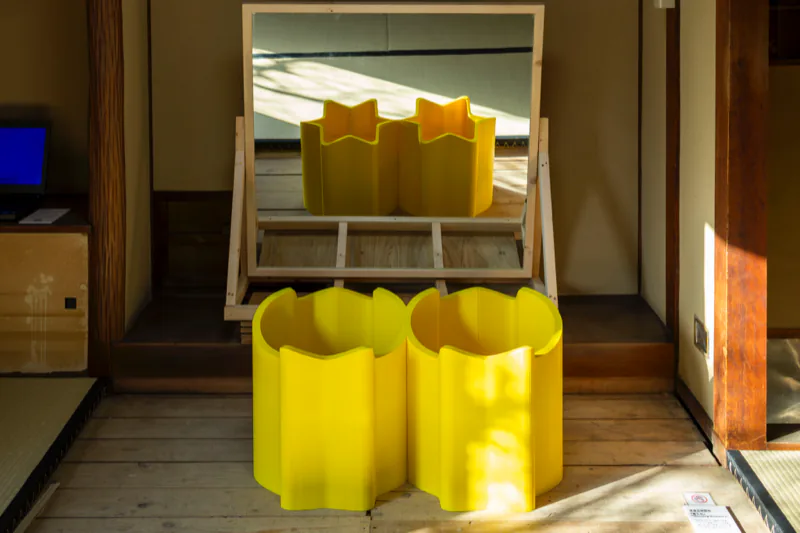
His research covers the brain’s sodium-level sensor, the Nax channel; vision and behavior in medaka fish; and optical illusions and deep learning. He also presents optical illusions of his own, among them “Morning Monster” (2020, with Lana Sinapayen) and “Sea of Eden, Fish Liberated from Optical Illusion,” invented during this exhibition.
Threads研究の柱
- The brain’s sodium sensor
- Sensing of sodium levels in body fluids by the Nax channel, and the control of salt intake (2002 Nat Neurosci, 2007 Neuron)
- Vision and behavior in medaka
- Predation induced by pink-noise motion (2012 Sci Rep); attraction to biological motion (2014 Anim Cogn)
- Optical illusions and AI
- Deep neural networks trained for prediction perceive the “rotating snakes” illusion as humans do (2018 Front Psychol, 2022 Sci Rep)
- Optical illusions of his own
- Watanabe illusion, Okazaki Genkikan Illusion, Morning Monster (2020), Sea of Eden, Fish Liberated from Optical Illusion (2025)
His research and art activities were introduced on the YouTube channel “Hakase to Dokeshi” (The Doctor and the Clown).
Biography略歴
- 1962Born in Osaka, Japan
- 1986Faculty of Science, Department of Biology, School of Science, Osaka University
- 1991Ph.D. in Engineering, Department of Biotechnology, School of Engineering Science, Osaka University
- 1992–95Researcher, Aichi Institute for Developmental Research
- 1995–98National Institute for Basic Biology, 感覚情報処理部門, Assistant Professor
- 1998–National Institute for Basic Biology, Laboratory of Neurophysiology (神経生理学研究室), Associate Professor
- 1998–School of Life Science, The Graduate University for Advanced Studies (Concurrent)
- 2002–06PRESTO Researcher, Japan Science and Technology Corporation (Concurrent)
- 2022–Office Chief of AI facility, 超階層生物学センター, National Institute for Basic Biology (Concurrent)
Books著書
- 2018『ロマンで古代史は読み解けない:科学者が結ぶ、地図と陰陽』 (co-author), Sairyusha. Roughly, “Ancient History Cannot Be Read as Romance: A Scientist Connects Maps and Yin-Yang”
- 2025『神経科学者と学ぶ深層学習超入門:AIの種を知り、知識の樹を育て、研究で最新モデルを使いこなす』, Yodosha. A beginner’s guide to deep learning for neuroscientists
Selected Papers主要論文
- 1995Watanabe E, Maeda N, Matsui F, Kushima Y, Noda M, Oohira A. Neuroglycan C, a novel membrane-spanning chondroitin sulfate proteoglycan that is restricted to the brain. Journal of Biological Chemistry 270, 26876–26882
- 2000Watanabe E, Fujikawa A, Matsunaga H, Yasoshima Y, Sako N, Yamamoto T, Saegusa C, Noda M. Nav2/NaG channel is involved in control of salt-intake behavior in the CNS. Journal of Neuroscience 20, 7743–7751
- 2002Hiyama TY, Watanabe E, Ono K, Inenaga K, Tamkun MM, Yoshida S, Noda M. Nax channel involved in CNS sodium-level sensing. Nature Neuroscience 5, 511–512
- 2007Shimizu H, Watanabe E, Hiyama TY, Nagakura A, Fujikawa A, Okado H, Yanagawa Y, Obata K, Noda M. Glial Nax channels control lactate signaling to neurons for brain [Na+] sensing. Neuron 54, 59–72
- 2010Watanabe E, Matsunaga W, Kitaoka A. Motion signals deflect relative positions of moving objects. Vision Research 50, 2381–2390
- 2012Matsunaga W, Watanabe E. Visual motion with pink noise induces predation behaviour. Scientific Reports 2, 219
- 2014Nakayasu T, Watanabe E. Biological motion stimuli are attractive to medaka fish. Animal Cognition 17, 559–575
- 2017Shimmura T, Nakayama T, Shinomiya A, Fukamachi S, Yasugi M, Watanabe E, et al. Dynamic plasticity in phototransduction regulates seasonal changes in color perception. Nature Communications 8, 412
- 2018Watanabe E, Kitaoka A, Sakamoto K, Yasugi M, Tanaka K. Illusory motion reproduced by deep neural networks trained for prediction. Frontiers in Psychology 9, 345
- 2022Kobayashi T, Kitaoka A, Kosaka M, Tanaka K, Watanabe E. Motion illusion-like patterns extracted from photo and art images using predictive deep neural networks. Scientific Reports 12, 3893
The full list of 33 papers is in the catalogue, pp.20–22.
Links to the Laboratory of Neurophysiology at the National Institute for Basic Biology and to Google Scholar will be added once the URLs are confirmed.