Holding back the results of his own research, he lined up the “Why?” that stands at the beginning of it: optical illusions with particularly striking impact, gathered regardless of their creators. The display re-enacts the experience a scientist has before starting to do research. (Summarized from Eiji Watanabe, “A Scientist, an Artist and Children Asking ‘Why?’”)
The numbers of the 16 items follow the list of works in the catalogue. Excerpts from the question box set up in the venue are later on this page. Images of the items without photographs (Akiyoshi Kitaoka’s illusions, the Tumblr dress) are not shown on this site.
①
Funhouse (balls rolling uphill)ビックリハウス(坂を登るボール)
The shift between visual information and the sense of equilibrium in this room creates in the viewer the feeling of perceiving a physically impossible phenomenon. Design instructions by the scientist, room constructed by the artist (the only joint work)
②
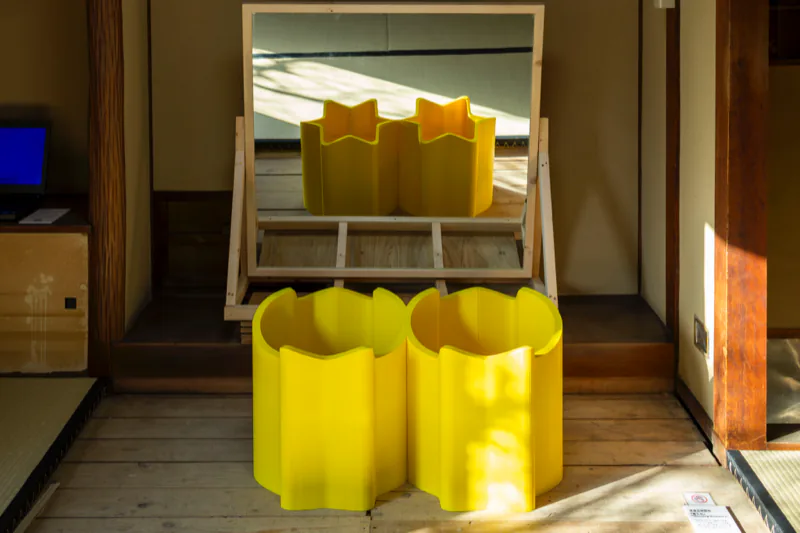
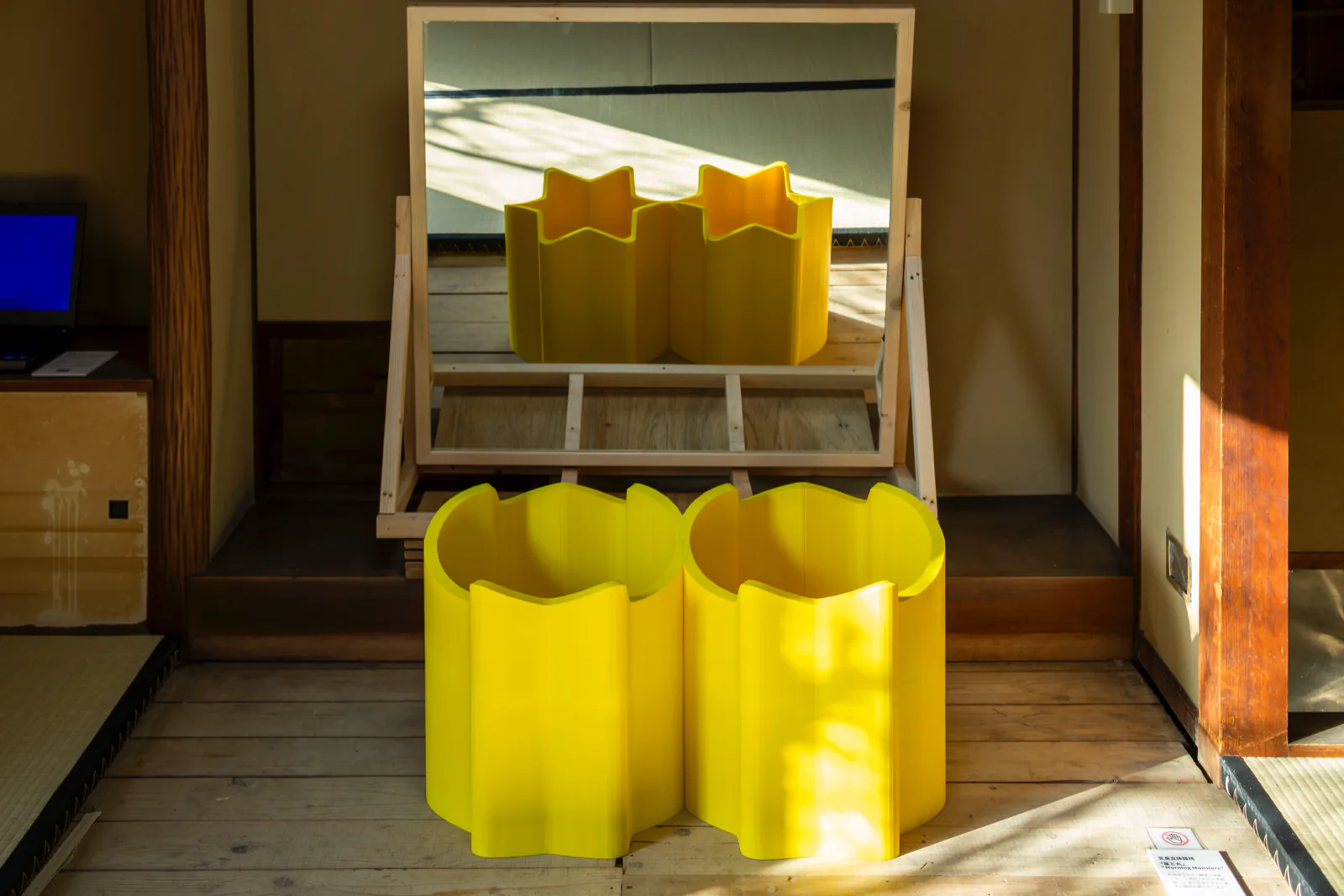
② “Transforming three-dimensional object (stars and circles),” Management BuildingPhoto: Kenji Aoki / Invented by Kokichi Sugihara (mathematician)Transforming three-dimensional object (stars and circles)変身立体(星丸)
Shapes in this three-dimensional optical illusion look completely different when seen from two different directions. Invented by Kokichi Sugihara (mathematician)
③
Optical illusion slide show錯視画像スライドショー
Presentation of 120 optical illusion images selected by Eiji Watanabe.
④
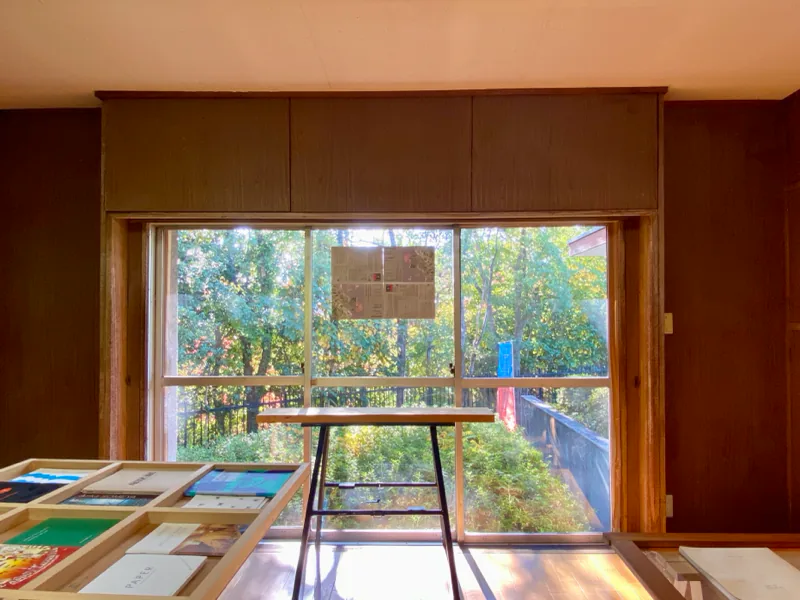
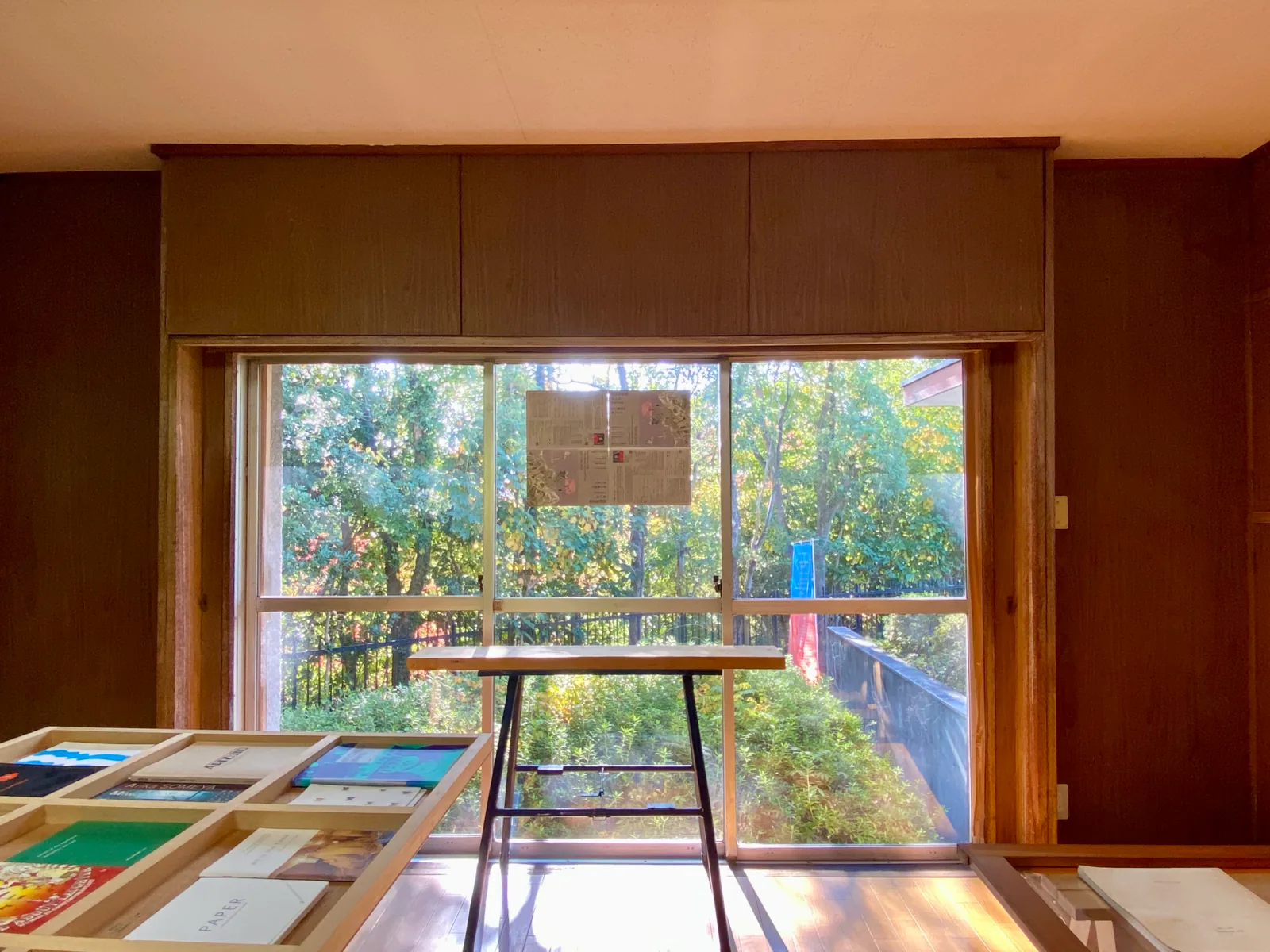
The “Okazaki Genkikan Illusion” box on a window of the Management BuildingPhoto courtesy of Art Obulist Executive CommitteeOkazaki Genkikan Illusion岡崎げんき館錯視
Seen through a structure mounted onto the window, the ridge line of a roof appears to be cracked. It is a type of Poggendorff illusion, whereas here the effect is amplified by moving the line of sight up and down. Created by Eiji Watanabe
⑤
Hands-on corner: Rotorelief体験コーナー:ロトレリーフ
Rotoreliefs are objects made by Marcel Duchamp, here spun by hand. Spinning a “Rotorelief” creates contradictory sensations of movement either toward or away from the viewer.
⑥
Hands-on corner: Benham’s Top体験コーナー:ベンハムのコマ
Benham’s Top and related items are disks with black and white arc-shaped patterns that create illusions of colors when rotating. When rotating in the opposite direction, the positions of the colors are reversed accordingly.
Transforming objects made by Kokichi Sugihara, with the additional effect of changing colors made by Eiji Watanabe. Kokichi Sugihara + Eiji Watanabe
⑧
Illusion of rotating snakes蛇の回転錯視
In this well-known optical illusion, circular snakes in still images appear to be rotating. In order to explain the principle behind this effect, Eiji Watanabe’s research team created a model of the human brain using AI based on unification prediction theory and trained it on moving images from a first-person perspective. Even without being instructed about the illusion, the AI perceived rotating motions in a way very similar to humans. The exhibited computer went on learning throughout the exhibition. By Akiyoshi Kitaoka (perception psychologist). The image can be seen on the creator’s website
A Logvinenko illusion, in which the luminosity of objects appears different from reality; the phenomenon of seeing a big moon near the horizon; and a “big car” illusion, in which the car in the background appears bigger. “Big car” illusion: Akiyoshi Kitaoka
⑩
Transforming three-dimensional object (squares and circles)変身立体(四角と丸)
Shapes in this three-dimensional optical illusion look completely different when seen from two different directions. Invented by Kokichi Sugihara (mathematician)
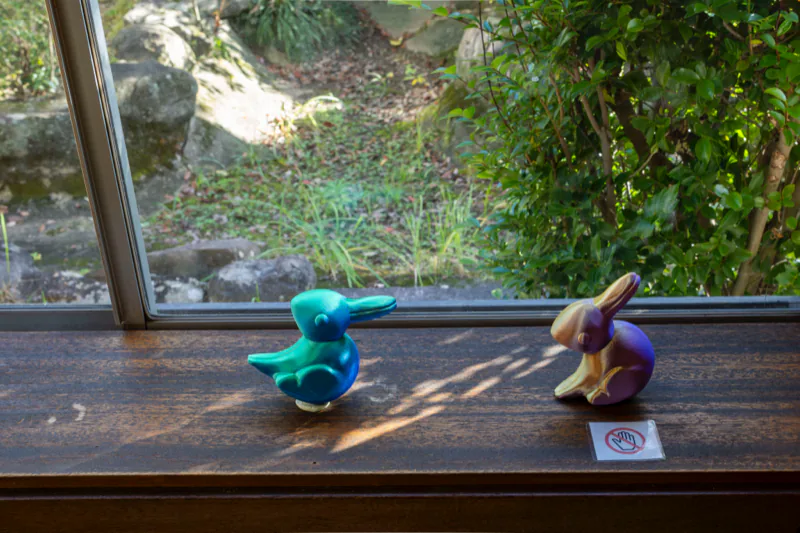
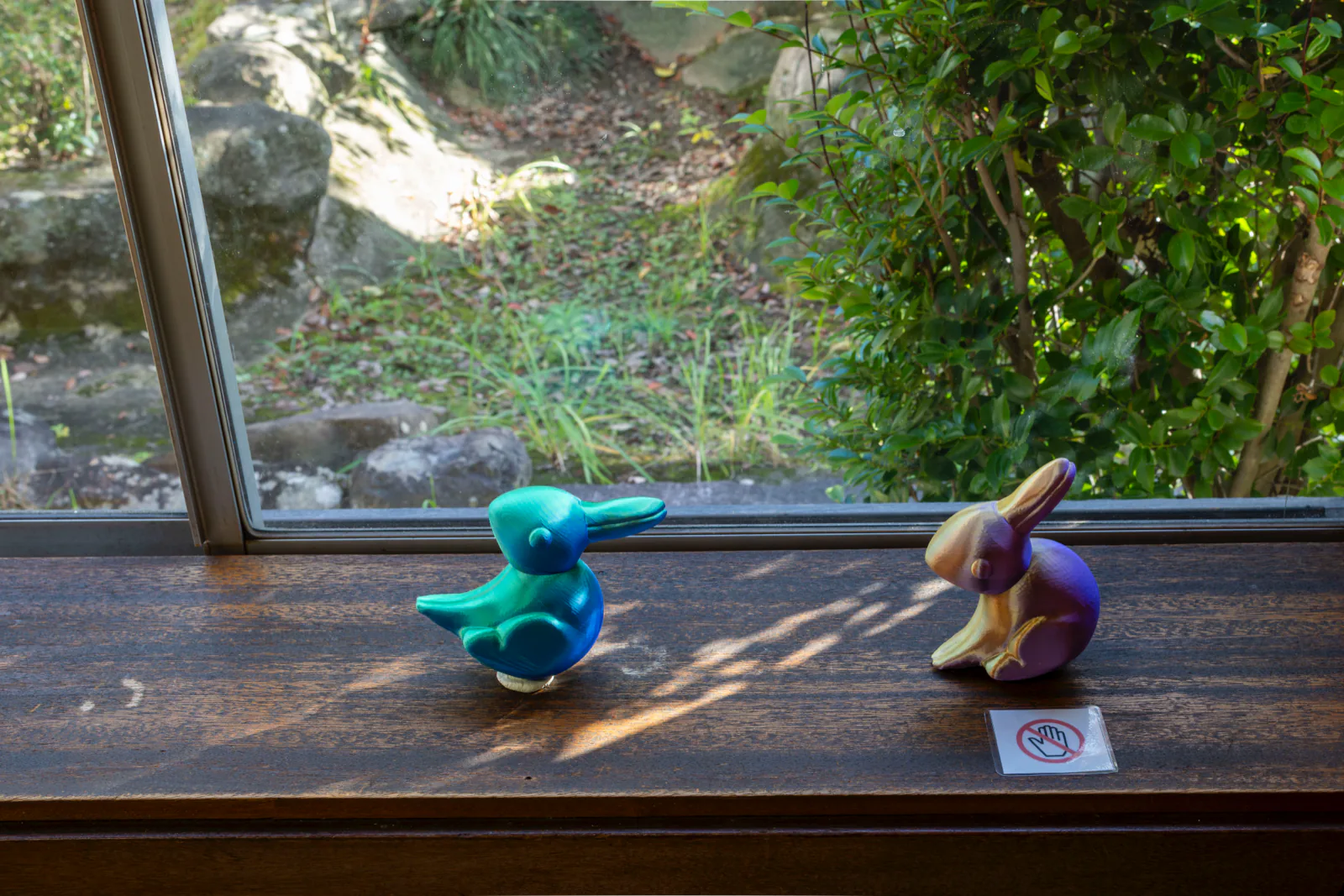
A 3D version of an illustration that looks like a rabbit to some viewers and like a duck to others. That either may be perceived, but never both at the same time, remains unchanged even when translated into 3D.
⑫
Sea of Eden, Fish Liberated from Optical Illusionエデンの海、錯視から解放された魚
While the sizes of the cars in the “big car” illusion change according to the sensation of perspective, the sizes of the fish illustrations, existing on a layer where perspective does not apply, are the same. A new type of optical illusion, discovered during the exhibition. Eiji Watanabe. A response to the artist’s “Sea of Eden”
⑬
Watanabe illusion渡辺錯視
The position of the arrival point on the extension of a diagonal line varies. The first optical illusion that Eiji Watanabe made by himself, shown here as an interactive display in which visitors mark their predicted arrival positions with stickers.
The Tree of Life Simulation, abbreviated “ToLSim,” computes the evolution from microorganisms that extract energy from light into various kinds of creatures, by way of mutation and environmental change. Research: Lana Sinapayen, Hyoyeon Lee
⑮
Optical illusion of different perceived colors人によって見える色が異なる錯視
This optical illusion became famous through a photograph that went viral on Tumblr in 2015. The colors of the dress are perceived as white and gold, blue and black, or other combinations.
⑯
Tunnel of Eden蝶瞰図(エデンのトンネル)
The butterflies of the artist’s work “Butterfly’s-Eye View” visualize the path that connects the Rest Building and the Management Building. An homage from the scientist to the artist
Ask questions to Eiji!渡辺英治質問箱
Five pairs from catalogue pp.13–15. The questioners’ names have been withheld.
Q1
How did it come about that our eyes can see things?Visitor
How it came about that our eyes can see things – that’s a riddle that has yet to be solved. I want to solve it, that’s why I keep researching. After all, the eye is a thing that living creatures have developed over a period of 3.5 billion years. It takes a very long time for living organisms to work out one new thing through trial-and-error, so the question is not that easy to answer!
Q2
What inspired you to do research in this field?Visitor
When I wake up in the morning and open my eyes, what I see is a magnificent, colorful world. To me, this is a very mysterious thing. I’m doing research in this field because I want to solve the riddle behind this mystery.
Q3
What made you feel like doing research about optical illusions?Visitor
Optical illusions make you think, “Wait a minute, what’s going on here?!” Now most people don’t think further than that, but I can’t sleep when I go to bed but there’s still a “Why?” in my head. That’s why I keep researching. When you look past the optical illusion itself, you get to the question, “What is a human being?”
Q4
Why do you know so many things?Visitor
Because the world gets more exciting the more you get to know about it!
Q5
What exactly is science?Visitor
“Science” is something that people do in order to know the world better. Every discovery is shared with the rest of the world so people can verify whether it’s true or not. The supporting pillar of science is an “open mind.”